






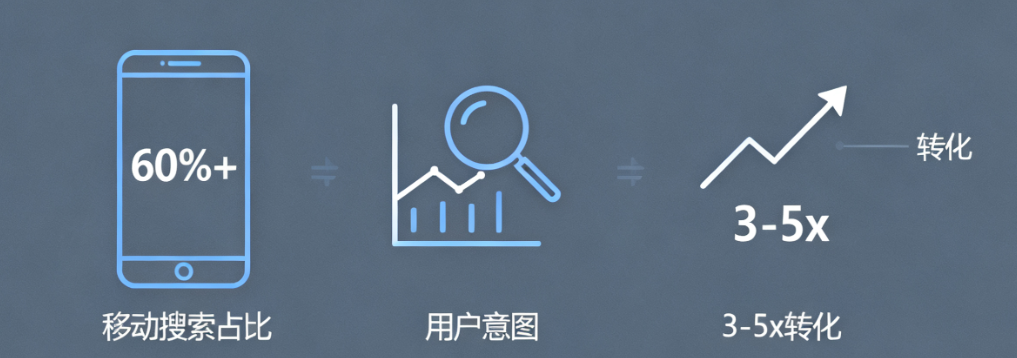
Data shows that content that meets the real needs of usersconversion rateCan improve 3-5 times. In today's mobile search accounted for more than 60%, mobile keyword software is far more than just providing search volume data, it is a rich mine of insight into user psychology. This paper will provide a complete framework from data interpretation to content landing based on empirical analysis.
I. Three major classifications and data characteristics of mobile search intent
Accurate categorization of search intent is the prerequisite for all subsequent analysis work. Due to the scenario-based nature of mobile search behavior, the intent is often more explicit and urgent.
1.1 Informational Intent
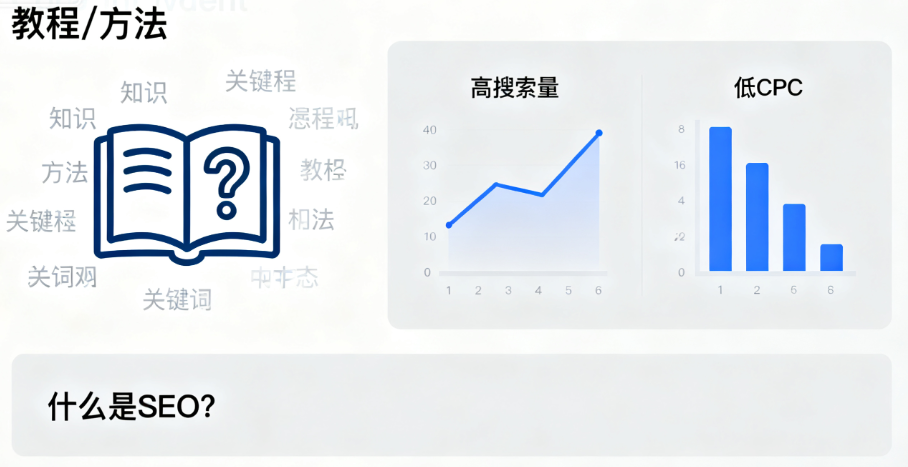
Users with informational intent aim to gain knowledge, answers, or solutions. Their search queries usually take the form of queries or foundational concepts.
- Data characterization performance: In keyword software, such termssearch volumemay be high, but business value metrics (e.g., cost-per-click)CPC) is usually low. Associated keywords are mostly "what", "why", "tutorial", "method", etc.
1.2 Navigational Intent
The essence of a user's desire to reach a particular website or page through a search engine is to use the search engine as an Internet navigator.
- Data characterization performance: Keywords usually contain brand terms, company names or specific product names. The difficulty of ranking is extremely low for the brand itself, and the value of the traffic is in the quick positioning.
1.3 Transactional intent
This means that the user is in the final stage of the buying decision and his/her search behavior has a clear commercial purpose.
- Data characterization performance: Keywords often include "buy", "price", "discount", "review", "near me" and other modifiers. These terms usually have the highest CPC and are the most competitive.
Second, the use of ranking software insight into the intent of the key operations
After mastering the theory of intent classification, the next step is to use the specific functions and data metrics in the software to identify and categorize the intent of a large number of keywords.

2.1 Interpretation of Core Indicators and Extrapolation of Intentions
The key data provided by the software is a direct clue to inferring intent.
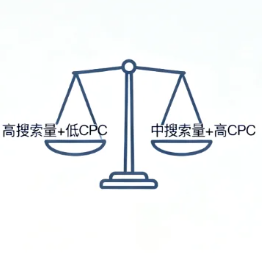
- Correlation analysis between search volume and CPC: A keyword with high search volume but low CPC has a high probability of being informational in intent. Conversely, a keyword with medium search volume but very high CPC strongly suggests transactional attributes.
- Filtering and categorization of keyword modifiers: Utilize the software's keyword filtering or grouping capabilities to create keyword clusters based on specific "intent modifiers". For example, create an "informational" group containing words with suffixes such as "tutorial", "step by step", "definition", etc.; create a "transactional" group containing words such as "cheap", "definition", etc.; and create a "transactional" group containing words such as "cheap", "definition", etc. Create "transactional" clusters containing words with suffixes such as "cheap", "buy", "package", etc.
2.2 SERP Functional Analysis and Intent Validation
The presentation of search results is itself a mirror of user intent.
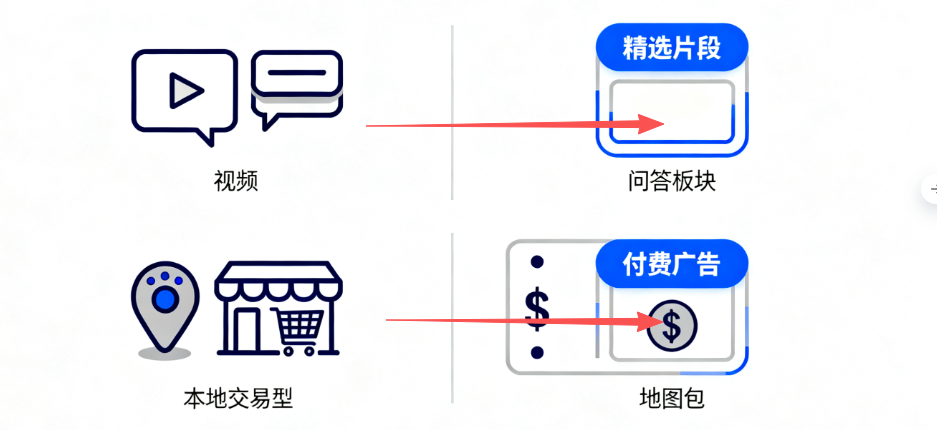
- Parses the composition of the search results page: See in the software which targeted keywords triggeredSERP FeaturesIf the results page is full of "Videos", "Featured Clips" and "Q&A" sections, this confirms the user's information seeking needs. If the results page is filled with "Videos", "Featured Clips" and "Q&A" sections, this confirms the user's information-seeking needs. If the results page shows "map packs" of local merchants and lots of paid ads, it validates their local transaction intent.
III. From intent to content: building a precisely matched content matrix
The ultimate goal of recognizing intent is to produce content that can perfectly take on that intent. Different types of content correspond to different user needs and search stages.
3.1 Content layout for informational intent
Informational search is the starting point for building trust and authority.
- In-depth guides and tutorial articles: Create step-by-step, detailed tutorials for keywords like "how to..." and "how to...".
- Q&A page with knowledge base: Create structured Q&A boards within the site for specific query terms, providing straightforward, clear and concise answers.
- Industry Insights & Blog Posts: Write in-depth analyses around core industry concepts and trends to engage early-stage prospects.
3.2 Content transformation for transactional intent
Transactional search users are the highest converting group and need direct, powerful content to drive their decisions.
![Image [1] - How to use ranking software to decipher what mobile searchers really want](https://www.361sale.com/wp-content/uploads/2025/11/20251110175003783-image.png)
- Product page optimization: Product page titles, descriptions and content should deeply integrate transactional keywords, clearly displaying prices, promotions, inventory and buy buttons.
- Professional review and comparison article: Providing users with an objective third-party perspective to help them choose between different products, this type of content is highly influential to users at the end of their decision-making process.
- Landing page with coupon page: Creating separate landing pages for specific promotions or offers ensures that search users see the most compelling call to action first.
Fourth, the actual process: a complete case of keyword intent analysis
Let's say we run a website that focuses on home coffee maker reviews and sales.

- Step 1: Data mining and initial grouping. Using the software's extension feature, a large number of mobile keywords were obtained around the seed term "coffee machine". The keywords were then initially grouped into "informational" (e.g., "how to use a coffee maker", "principles of espresso machine"), "commercial" and "investigative" (e.g., "best coffee maker brands", "coffee maker reviews") based on modifiers. Investigative" (e.g., "Best Coffee Maker Brands", "Coffee Maker Reviews") and "Transactional" (e.g., "Dillon Coffee Maker Buying"). Delonghi Coffee Maker Buying", "Coffee Maker Discounts").
- Step 2: SERP Characterization and Competitive Analysis. Examining the search results for the keyword "business research-based" shows that the top three results are all articles from professional review sites. This suggests that creating a "Top 10 Coffee Makers Review" article that is more comprehensive and objective than the existing results is the best form of content to take on this intent.
- Step 3: Content Creation and Effectiveness Tracking. Write and publish the review article based on the analysis. Properly lay out all relevant business research-based keywords in the article. After the article goes live, continually track the ranking changes and traffic generated by these keywords in the software as a way of assessing the success of matching the content to the intent.
reach a verdict
Mobile search optimization has evolved from the simple matching of keywords to the deep understanding and satisfaction of user intent. Keyword ranking optimization software plays the dual role of radar and translator in this process. It not only detects the user's search behavior, but also interprets the motivation behind the behavior. Combining the software's data insight capability with the system's content strategy to build a content matrix that is highly aligned with the user's search intent is the fundamental path to winning attention, building trust, and ultimately realizing business goals in the crowded mobile search environment.

Link to this article:https://www.361sale.com/en/79992/The article is copyrighted and must be reproduced with attribution.













![Emoji[wozuimei]-Photonflux.com | Professional WordPress repair service, worldwide, rapid response](https://www.361sale.com/wp-content/themes/zibll/img/smilies/wozuimei.gif)

![Emoticon[baoquan] - Photon Wave Network | Professional WordPress Repair Services, Worldwide Coverage, Rapid Response](https://www.361sale.com/wp-content/themes/zibll/img/smilies/baoquan.gif)


 简体中文
简体中文  English
  日本語
日本語  Français
  Español


No comments