







为什么需要自动化运营日报?
做运营的人都知道,每天早上第一件事就是整理昨天的数据:流量多少、转化多少、哪篇文章涨了、哪个渠道掉了。这件事重复、机械、但又不能不做。
OpenClaw 的定时任务(Cron)功能可以让 AI 每天固定时间自动生成日报,并推送到你的 Telegram 群、Discord 频道或 Slack workspace。你早上打开手机,日报已经在群里等着你了。
这篇教程教你从零配置一个每日自动运营日报。
整体思路
实现自动日报需要三个部分配合:
- 调度器(Schedule):告诉 OpenClaw 什么时候执行,比如每天早上 9 点
- 执行体(Payload):告诉 AI 要做什么,比如”生成昨天的运营数据摘要”
- 推送(Delivery):告诉 OpenClaw 把结果发到哪里,比如 Telegram 群
三者组合起来就是一个完整的 cron job。
第一步:理解 Cron 定时任务机制
OpenClaw 的 Cron 运行在 Gateway 进程内部,不依赖系统的 crontab。它有三种调度方式:
- at:一次性任务,到点执行一次就删除
- every:固定间隔重复,比如每 6 小时一次
- cron:标准 cron 表达式,支持时区设置
做日报用 cron 类型最合适,因为你需要”每天早上 9 点”这种精确的时间控制。
第二步:创建每日 9 点执行的 Cron Job
用 CLI 一行命令就能创建:
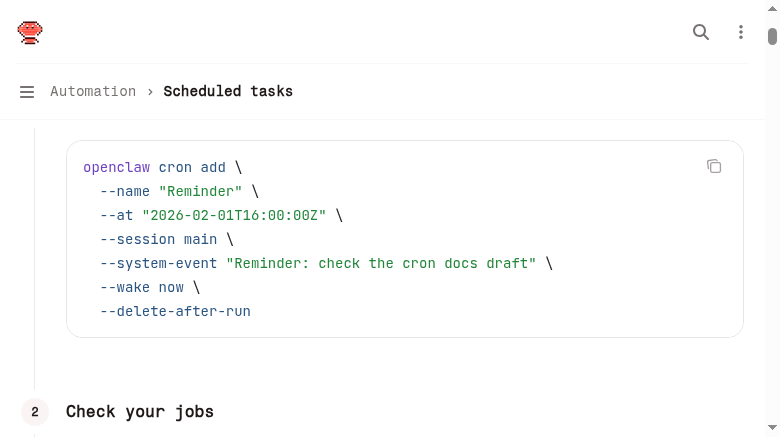
openclaw cron add \
  --name "每日运营日报" \
  --cron "0 9 * * *" \
  --tz "Asia/Shanghai" \
  --session isolated \
  --agent-turn "请生成昨天的运营数据日报,包括:网站总流量、Top 5 文章、新增收录数、关键词排名变化、异常告警。用简洁的列表格式输出。" \
  --delivery announce \
  --delivery-channel telegram \
  --delivery-to "-100123456789"
这条命令做了什么:
--cron "0 9 * * *":每天 9:00 执行--tz "Asia/Shanghai":按上海时间算(不设的话默认 UTC)--session isolated:在独立会话中执行,不影响你的主对话--agent-turn "...":让 AI 执行的具体指令--delivery announce:执行完把结果推送出去--delivery-channel telegram:推送到 Telegram--delivery-to "-100123456789":目标群组 ID
第三步:配置 Payload——让 AI 知道该做什么
Payload 是 cron job 的核心,决定 AI 执行什么任务。对于日报场景,你需要在 prompt 里写清楚:
- 要汇总哪些数据
- 数据来源是什么(Google Analytics、Search Console、数据库)
- 输出格式是什么
如果你的 AI 已经配置了相关工具(比如能访问 Google Analytics API),它就能自动拉取真实数据。如果没有,它会基于你之前的对话记录和记忆生成摘要。
用 JSON5 格式写配置文件会更清晰:
{
  name: "每日运营日报",
  schedule: {
    kind: "cron",
    expr: "0 9 * * *",
    tz: "Asia/Shanghai"
  },
  payload: {
    kind: "agentTurn",
    message: "请生成昨天的运营数据日报。包括:1) 网站总 UV/PV;2) Top 5 流量文章;3) Google 新收录页面数;4) 关键词排名变化(涨/跌超过 3 位的);5) 异常告警(如果有 5xx 错误或流量暴跌)。用简洁列表格式,不要废话。",
    timeoutSeconds: 120
  },
  delivery: {
    mode: "announce",
    channel: "telegram",
    to: "-100123456789"
  },
  sessionTarget: "isolated"
}
把这个保存为 daily-report.json5,然后用命令导入:
openclaw cron add --file daily-report.json5第四步:配置 Delivery——把日报推送到群里
OpenClaw 支持三种推送方式:
- announce:推送到聊天渠道(Telegram/Discord/Slack 等)
- webhook:POST 到一个 URL(适合对接内部系统)
- none:不推送,只记录(适合调试)
推送到不同平台的配置示例:
推送到 Telegram 群
{
  delivery: {
    mode: "announce",
    channel: "telegram",
    to: "-100123456789"
  }
}
推送到 Discord 频道
{
  delivery: {
    mode: "announce",
    channel: "discord",
    to: "1234567890"
  }
}
推送到 Slack
{
  delivery: {
    mode: "announce",
    channel: "slack",
    to: "C0123456789"
  }
}
怎么找群组 ID?
- Telegram:把 Bot 加入群组后,在
openclaw logs --follow里看 chat.id - Discord:开启开发者模式,右键频道复制 ID
- Slack:频道详情里的 Channel ID
第五步:查看运行历史
创建 cron job 后,你可以随时查看它的执行记录:
# 列出所有 cron job
openclaw cron list

# 查看某个 job 的详情
openclaw cron get <job-id>

# 查看执行历史
openclaw cron runs --id <job-id>

# 手动触发一次(用于测试)
openclaw cron run <job-id>
建议创建完之后先用 openclaw cron run 手动触发一次,确认 AI 能正常生成日报、推送能正常到达,再等第二天自动执行。
第六步:常见问题排查
如果日报没有按时推送,按以下顺序排查:
- (of a computer) run
openclaw cron list确认 job 状态是 enabled - (of a computer) run
openclaw cron runs --id <job-id>看最近一次执行是 succeeded 还是 failed - 如果是 failed,检查 payload 里的 prompt 是否有问题
- 如果是 timed_out,增加 timeoutSeconds 的值
- 如果推送没到达,检查 delivery 的 channel 和 to 是否正确
common problems
Q1:cron job 创建后多久开始执行?
创建后立即生效。如果你在下午 3 点创建了一个”每天早上 9 点”的任务,它会在第二天早上 9 点第一次执行。想立即测试,用 openclaw cron run <job-id>The
Q2:Gateway 重启后 cron job 会丢失吗?
不会。所有 job 定义持久化在 ~/.openclaw/cron/jobs.json,重启后自动恢复。
Q3:能不能让日报包含真实的 Google Analytics 数据?
可以,但需要给 AI 配置相应的工具(MCP server 或 API 访问权限)。如果没有配置数据源工具,AI 只能基于它已有的记忆和上下文生成摘要。
Q4:一个 cron job 能同时推送到多个群吗?
目前一个 job 只能配置一个 delivery 目标。如果需要推送到多个群,创建多个 job,payload 相同但 delivery.to 不同即可。
Q5:时区设置错了怎么改?
expense or outlay openclaw cron update <job-id> --tz "Asia/Shanghai" 修改。或者直接编辑 ~/.openclaw/cron/jobs.json,Gateway 会自动检测文件变化并重新加载。
Q6:执行超时怎么办?
默认超时时间可能不够复杂任务使用。在 payload 里加 timeoutSeconds: 300(5 分钟)给 AI 更多时间。如果任务确实很重,考虑拆分成多个小任务。
相关教程推荐
- OpenClaw 怎么做数据分析日报?每天 5 分钟掌握网站运营状态
- OpenClaw 怎么做内容排期?把关键词研究变成可执行的发布计划
- OpenClaw 怎么复盘 SEO 数据?从收录检查到内容优化的完整流程
summarize
用 OpenClaw 做自动化日报的核心就是三步:设好时间(schedule)、写好指令(payload)、配好推送(delivery)。一次配置,每天自动执行,再也不用早上手动整理数据了。
更多定时任务的高级用法,参考官方文档:OpenClaw Scheduled Tasks 文档The
官方文档:OpenClaw 定时任务文档

Link to this article:https://www.361sale.com/en/87565/The article is copyrighted and must be reproduced with attribution.





 简体中文
简体中文  English
  日本語
日本語  Français
  Español


0
Now definitely still do SEO, just play changed. Previously rely on heaps of content, heaps of keywords can have traffic, and now pay more attention to the quality of content + brand trust + user experience. In addition to relying solely on SEO is actually more and more difficult, a lot of good basically SEO + social media + content marketing + private domain conversion to do together. SEO is still a long-term customer acquisition channel, but can no longer be taken as the only channel.Hehe is working.
March 11, 10:540
Normal, included only on behalf of Google to see the page, does not mean that the ranking immediately, "has been included but not ranked" usually because: Keyword competition, page weight is low, the content is not strong enough, the page is relatively new. Continue to optimize the long-tail keywords, content quality and internal chain, usually takes a little time, the ranking will slowly come out!Amelia Foster March 6, 16:200
Do you have a screenshot?lit. even a son who is not a fish knows the joy of fish March 6, 09:230
Don't pile on the optimization plugins first, locate the bottlenecks first: Use Query Monitor to see slow SQL, slow hooks. Pause all plugins for comparison, then turn them on one by one. Check autoload is too big (options table). Check database indexes with large table queries. Tackle host/database performance first if server TTFB is high.Hehe is working.
March 3, 16:470
Hi Windjammer, there's really no need to mess with complicated local environments, regular people follow these steps and the update basically won't crash the site 👇 First, backup the whole site, files + database are prepared, this is the bottom line, out of the problem can be a key to go back. Don't change the whole thing in one click, change it in batches, change the unimportant plug-ins first, and then change the core ones. Immediately after the update, clear the cache, go to the foreground to check the home page, article page, buttons, forms, these key positions. It is best to install a plug-in that supports version rollback, in case of a crash, cut back to the old version in a second. To summarize: backup first, change in batches, check after changing, leave a way back, stable ✅😎 Hope this helps!bugbang March 2, 09:550
Usually it's not that the payment didn't work, but that the callback (webhook) didn't write back the order status. Troubleshooting steps: WooCommerce → Status → Logs: see if the payment gateway has webhook error / signature error / timeout Check if the site is blocked by WAF (Cloudflare, Pagoda Firewall, security plugins) Check if "Cache checkout pages/interface paths" is enabled (checkout pages and callback interfaces should not be cached) Look at the server error logs for 500/fatal errors that interrupt the callback execution. Solution: Release wp-json, wc-api, payment gateway callback URLs (configure as per gateway documentation) Disable cache and JS merge compression test on checkout page once If using Cloudflare: set no-challenge, no-block rules for callback URLsUlla Nala Zhenhuan (18嬛嬛嬛) January 31st, 09:360
1) Determine whether it is "Normal Waiting" or "Abnormally Stuck". You can first look at 3 signals: whether the page release time is within 7-14 days, whether there are only a small number of pages with this status, and whether the page has appeared in the XML Sitemap. If all three are satisfied, most likely belong to the normal crawling and evaluation stage, do not need to do it immediately. 2) Under what circumstances is it useless to "wait"? The following cases will not be solved automatically by time: the page has almost no internal links (isolated page), the content is highly similar to the existing pages on the site, canonical points to other URLs, and too many similar articles are published on the same topic for a short period of time. In this case, Google has been crawled, but judged that "it is not worth entering the index". 3) The most effective way of manual intervention (no tossing) Prioritize these 3 things: add internal links, link to the page from related old articles or columns, and enhance the density of information on the first screen. The first 2-3 paragraphs directly answer the user's question, avoid too much padding, confirm canonical as self-referential, avoid being judged as a duplicate page, and then go to GSC to request reindexing after doing so. 4) What "intervention actions" are counterproductive? It is not recommended: frequent deletion and reposting, clicking "request to index" several times in a row, forcing keywords to be stacked for indexing, changing URLs or titles arbitrarily. These operations will allow Google to reassess the stability of the page, but slow down the inclusion. 5) a practical judgment standard If an article: has been crawled, there is no noindex / robots problem, there are at least 1-2 related internal links, the content obviously solves an independent problem, then it is included, just a matter of time, not a plug-in problem.Post Porter January 30th 10:000
The new station does not do external links can be completely, the first content and station structure to do a good job more stable. Only rely on the content can generally get included and part of the long-tail word rankings, but the amount of high competition will be slow. It is recommended to wait for the site stable inclusion, 30-50 quality content, keywords began to enter the top 20/30, and then a small amount of external links, priority brand words/naked chain/citation type, do not come up to chase the number. 👍