







In the realm of WordPress development, selecting a data storage solution constitutes a fundamental and critical architectural decision that directly impacts both the cost of later performance optimization and the complexity of data migration.wp_postmetaThe table serves as the platform's built-in metadata management system, storing extension data for over 90% plugins. This approach, alongside the custom data table—an independently designed storage solution—represents two fundamentally different design philosophies and technical paths. Industry data indicates that incorrect choices lead to a 35% mid-project restructuring rate, increasing average maintenance costs by 140 man-hours.
Understanding their inherent characteristics, performance capabilities, and applicable boundaries enables developers to make informed architectural choices early in projects. This approach prevents the accumulation of technical debt that leads to maintenance difficulties later on, while keeping data query efficiency differences within a range of up to 20 times.
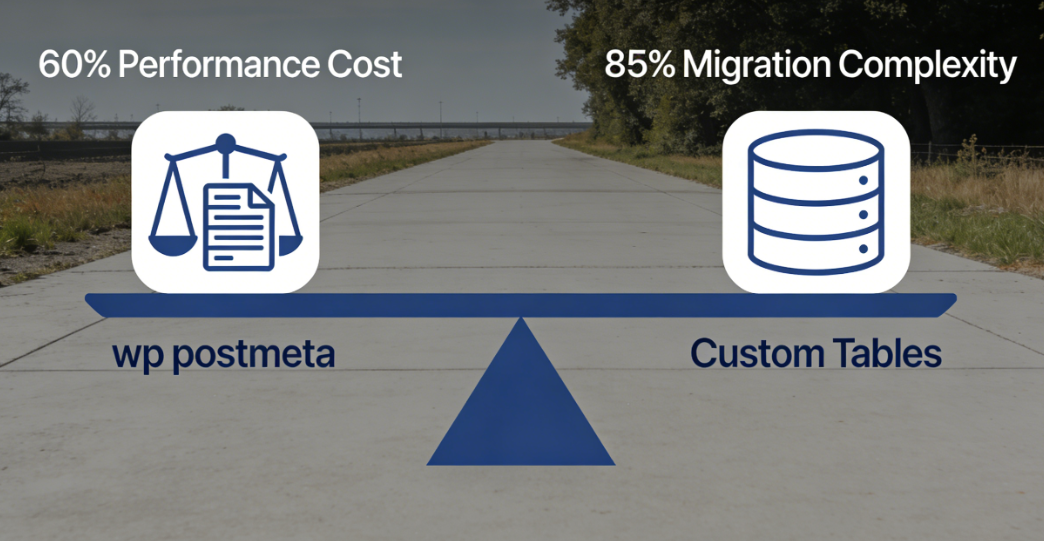
I. The Difference Between Architectural Essence and Design Philosophy
1.1 wp_postmeta: A Flexible, Priority-Based EAV Model
WordPresswp_postmetaThe table employs the classic entity-attribute-value design pattern. Its core principle is to treat the data structure itself as part of the data to be stored, rather than fixing it during the database design phase.
At the technical implementation level, each metadata record comprises four fundamental components: a unique identifier, the associated article ID, the attribute name string, and the corresponding attribute value. All values are stored in plain text format, with the system relying on application-level logic to interpret their specific types.
The greatest advantage of this design is its ease of extension. When new attributes need to be added to posts, developers don't need to modify the database structure—they simply use the new attribute names in their code. This zero-schema-change feature allows plugins and themes to effortlessly extend WordPress's core data model without complex migration operations.
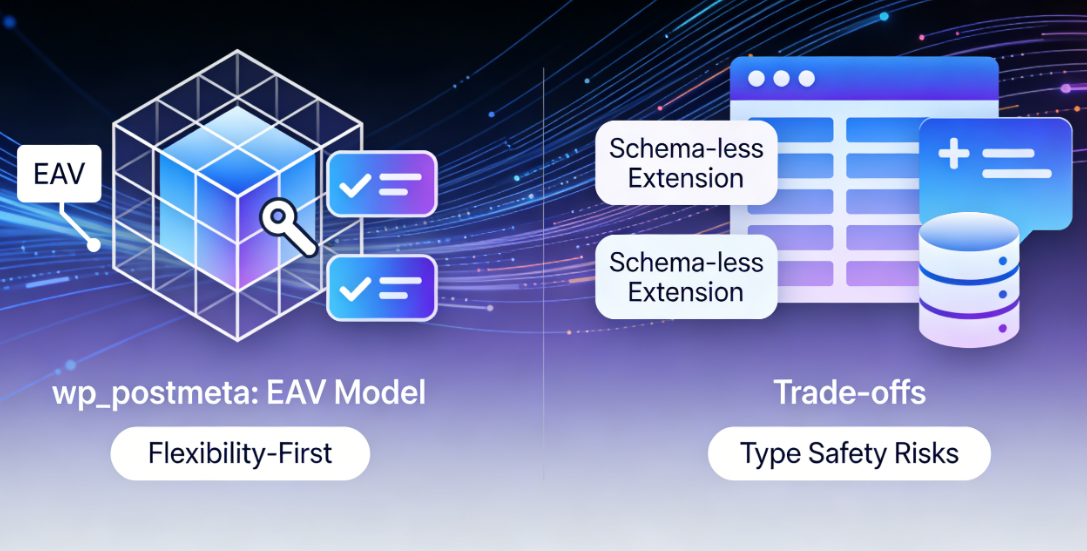
The price of flexibility is the loss of type safety. Since all values are stored as text, the database cannot enforce data type constraints, shifting the responsibility for data validation entirely to the application code. This increases the risk of data inconsistency and makes value-based query operations less efficient.
1.2 Custom Data Tables: Structure-First Normal Form Design
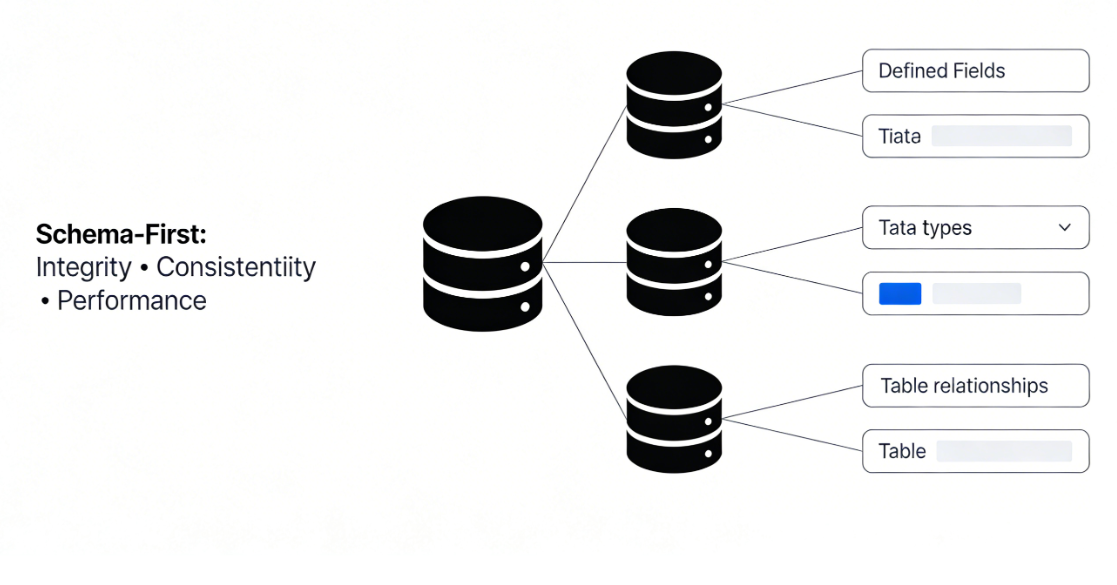
Custom data tables adopt traditional relational database design methodologies. During the design phase, developers explicitly define table structures, including field names, data types, constraints, and relationships between tables.
The core advantage of this paradigm-based design lies in data integrity and consistency. The database engine performs data type checks, foreign key constraints, and other validations at the storage layer to ensure data correctness. Fields possess explicit semantics and types, enabling the query optimizer to generate efficient execution plans.
Designing custom tables requires developers to have a clear understanding of data structures early in the project. While table structures can be modified later through migration operations, this is significantly more complex than simply adding a new metadata attribute. This upfront investment yields substantial improvements in query performance and standardized data management down the line.
II. Objective Analysis of Query Efficiency and Performance
2.1 Performance in Simple Query Scenarios
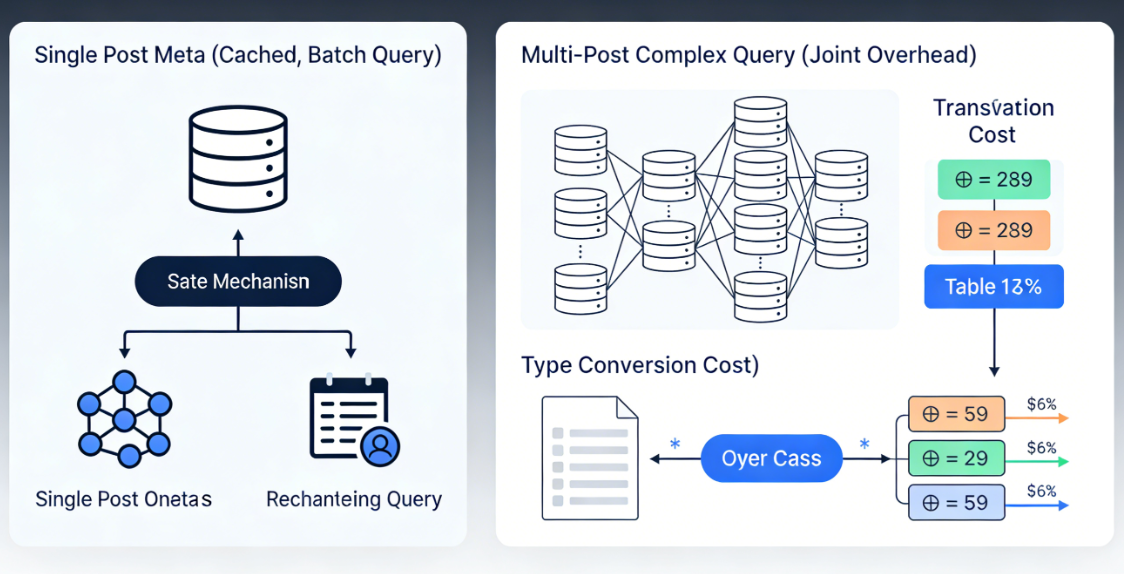
For metadata operations based on individual articles,wp_postmetaAfter optimization, the table can deliver acceptable performance.WordPressThe built-in caching mechanism stores recently queried metadata, reducing direct access to the database. When retrieving all metadata for an article, the system executes a single query to fetch all relevant records. This batch processing approach alleviates performance pressure to a certain extent.
However, in scenarios involving multiple articles and complex filtering criteria,wp_postmetaPerformance bottlenecks become apparent. Since each attribute value is stored as a separate row, attribute-based queries require extensive join operations or subqueries. Particularly when performing range queries, sorting, or aggregation calculations, the database must convert text values into appropriate types—this additional step significantly increases query overhead.
2.2 Comparative Testing in Complex Query Scenarios
Consider a typical product catalog scenario: you need to query all products within a specific price range, with sufficient inventory, and belonging to a specific category. Usingwp_postmetaThe solution requires at least three table joins for this query, each join based on the article ID and a specific attribute name. As the number of filter conditions increases, the query complexity grows linearly.
In contrast, the custom data table approach stores all these attributes in different columns within the same row. Queries can be simplified to conditional filtering on a single table, and the database can accelerate this process using composite indexes. Test data shows that on datasets containing tens of thousands of records, queries using the custom table approach typically outperformwp_postmetaThe solution is 5 to 20 times faster, with the exact difference depending on query complexity.
2.3 Performance Considerations for Write Operations
In terms of data writing, the differences between the two approaches are equally pronounced.wp_postmetaEach update involves independent row operations. When a post requires updating a large amount of metadata, it generates multiple database write requests. Although WordPress attempts to batch these operations, the underlying process still consists of multiple independent inserts or updates.
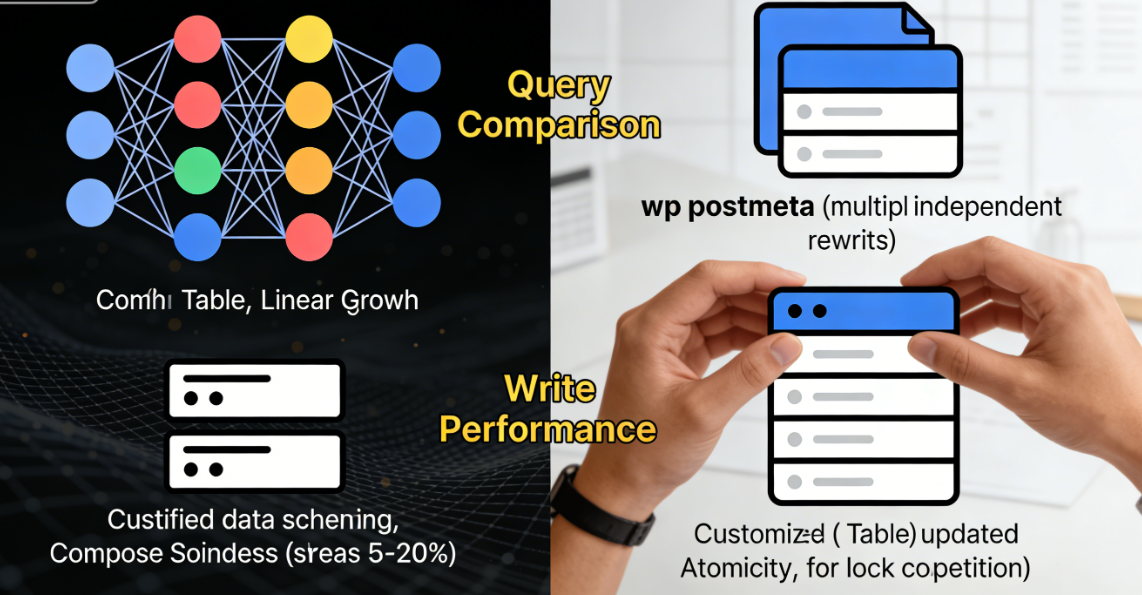
Updates to custom data tables are typically performed within a single row, and the database's transaction processing mechanism ensures the atomicity of related field updates. This single-operation model reduces database lock contention, delivering superior performance stability in high-concurrency write scenarios.
III. Comprehensive Evaluation of Scalability and Long-Term Maintenance
3.1 The Complexity of Data Structure Evolution
Project requirements evolve over time, and data storage solutions must adapt to this progression.wp_postmetaSchema-less solutions offer inherent advantages in handling field additions and removals. Adding new fields requires no database schema changes—merely start using the new property names in your code. This flexibility is highly appealing in rapidly iterating development environments.
However, this flexibility can also become a maintenance burden. Over time, different versions of plugins may use different property names to store data with identical meanings, or the same property name may carry different meanings in different contexts. Without clear architectural documentation, such implicit data structures become difficult to understand and maintain.
Custom data tables require explicit structural changes. Adding new fields necessitates execution.ALTER TABLEstatementThis requires stricter change management and potential downtime. However, such explicit changes create clear architectural documentation, with every addition, modification, or deletion of a field explicitly recorded. From a long-term maintenance perspective, this clarity often proves more valuable than short-term convenience.
3.2 Compatibility with the WordPress Ecosystem
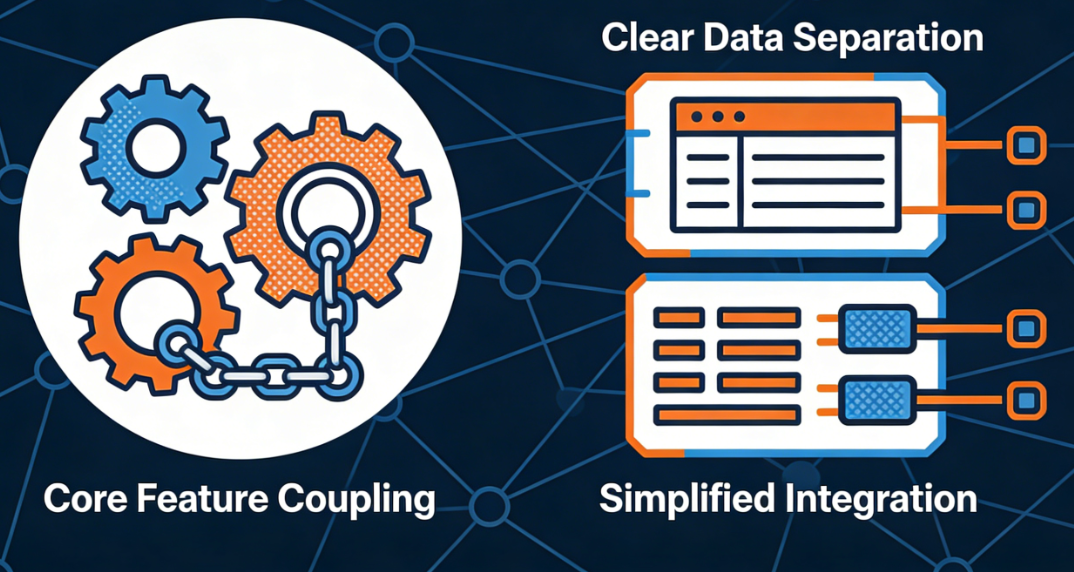
wp_postmetaOne significant advantage is its deep integration with WordPress core functionality. Many built-in features, such as post revisions, automatic draft saving, and the trash system, are tightly coupled with the metadata system. Using custom data tables means either implementing these integrations yourself or accepting the absence of certain core functionalities.
On the other hand, custom data tables provide clearer boundary separation. Business data and content management data are stored in distinct physical tables. This separation makes the data model easier to understand and simplifies backup and recovery strategies. For scenarios requiring integration with external systems, clear data boundaries reduce coupling complexity.
3.3 Complexities of Migration and Data Conversion
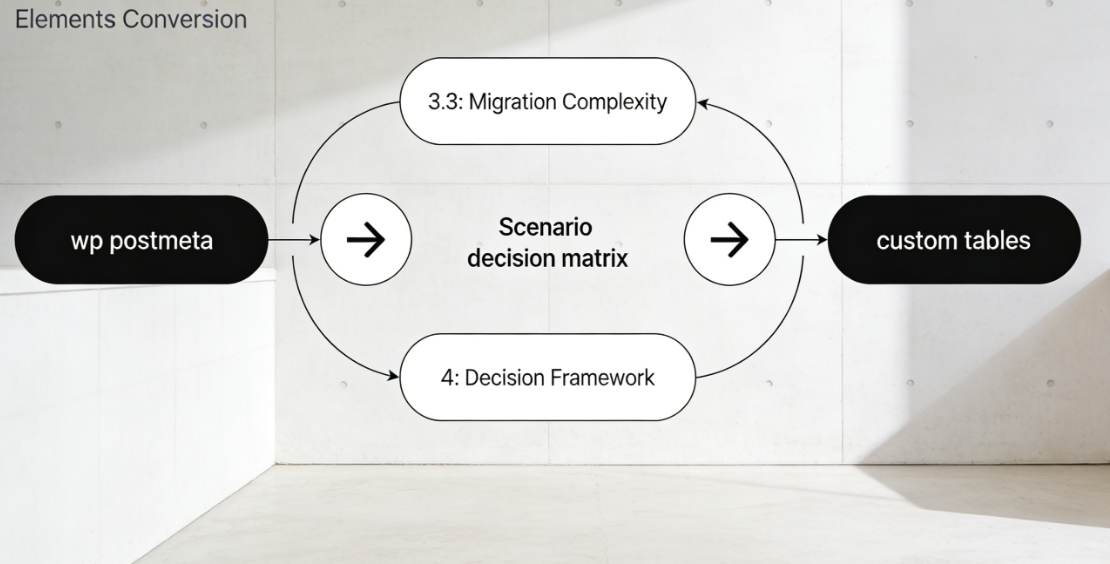
When the project transitions fromwp_postmetaThe primary challenge encountered when migrating the solution to a custom data table solution isData cleansingData and structural transformation. Data in metadata tables may contain inconsistent formats, duplicate records, or invalid values. The migration process requires careful handling of these data quality issues.
Migrating in the opposite direction involves lower complexity but may result in partial information loss. Strict type constraints in custom tables may lose precision or semantic information when converted to text storage.
IV. Practical Guidance: A Scenario-Based Decision-Making Framework
4.1 Identify Suitable Use Cases for wp_postmeta
Certain types of projects are better suited forwp_postmetaSolutions. These projects typically exhibit the following characteristics: simple and stable data structures with a limited number of attributes per entity; query patterns centered around individual entities, rarely requiring complex cross-entity queries; small project scale with limited data volume; and a need to fully leverage WordPress's built-in features, such as revision history and auto-saves.
Typical use cases include simple content-based websites, blog platforms, and promotional showcase pages. In these scenarios, metadata requirements for content are relatively fixed, performance demands are low, and development efficiency takes precedence over execution efficiency.
4.2 Identifying Project Characteristics Requiring Custom Data Tables
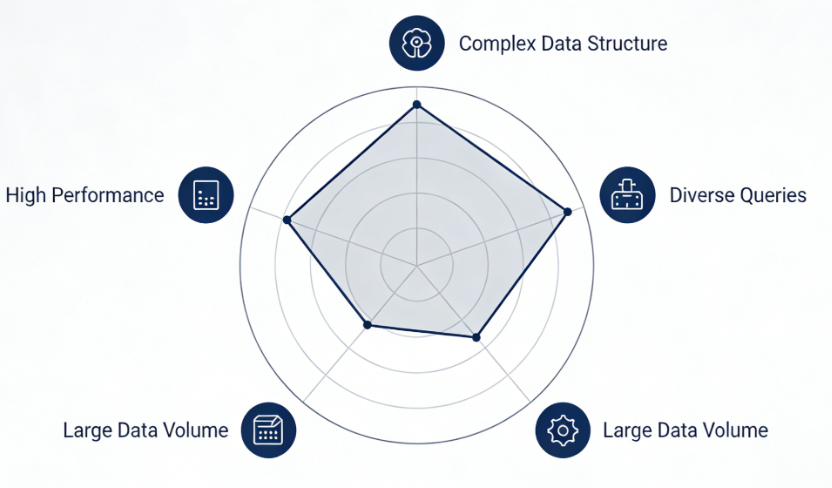
When a project exhibits the following characteristics, a custom data table solution should be seriously considered: - Complex data structures with well-defined business entities and relationships; - Diverse and intricate query requirements involving multi-condition filtering, aggregation calculations, or sorting operations; - Anticipated significant data growth reaching tens of thousands or even millions of records; - Need for data exchange or integration with external systems; - High demands on query performance, where response times directly impact business outcomes.
Typical application scenarios include e-commerce platforms, membership management systems, online booking systems, learning management systems, and more. These systems typically feature well-defined business models, complex data relationships, and stringent performance requirements.
4.3 The Prudent Application of Mixed Strategies
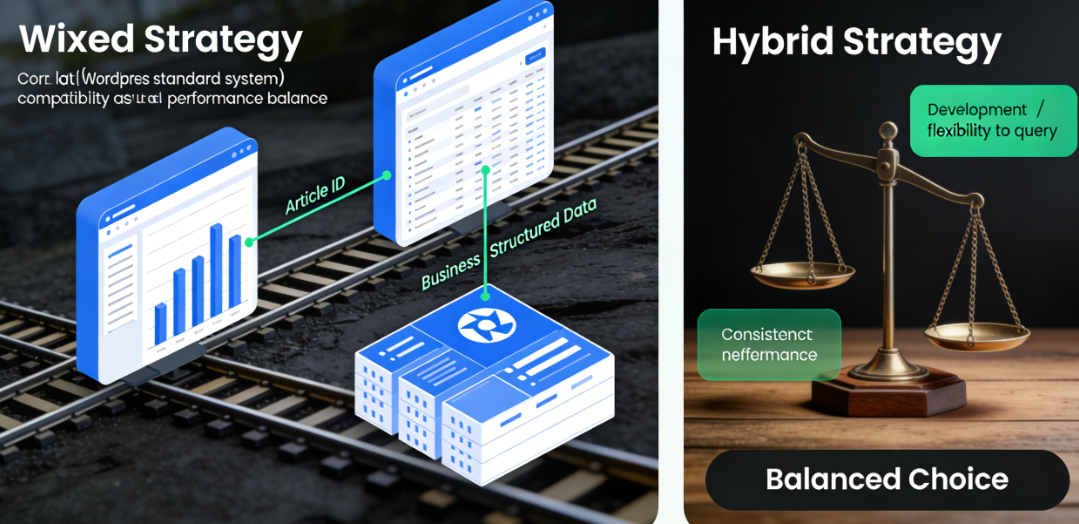
In real-world projects, adopting a single solution exclusively may not be the optimal choice. A hybrid strategy allows selecting the most suitable storage method based on the characteristics of different data types.
Core content data can continue to use WordPress's standard posts andMetadata SystemMaintain full compatibility with platform functionality. Business-specific structured data is stored in custom data tables to achieve performance advantages and type safety. The two systems are linked via article IDs, enabling data correlation queries when required.
This hybrid approach balances compatibility with performance, development efficiency with execution efficiency. It demands more meticulous architectural design, yet often delivers the best overall results in complex projects.
V. Conclusion: The Art of Balance
Selecting a data storage solution is essentially a process of balancing requirements across different dimensions.wp_postmetaThe solution offers advantages in development efficiency, flexibility, and ecosystem integration, while custom data tables deliver superior performance in query efficiency, data consistency, and long-term maintainability.
There is no single correct answer; only the most appropriate choice for a specific context. This decision should be based on a deep understanding of project requirements, a reasonable prediction of data growth patterns, and an objective assessment of the team's technical capabilities. Wise developers invest time in architectural analysis early in the project, as choices made at this foundational level will have lasting implications throughout the project's entire lifecycle.
As WordPress evolves into a more comprehensive application platform, the choice of data storage architecture becomes increasingly critical. Whether adhering to the built-in metadata system or introducing custom data tables, the goal remains to build a reliable, maintainable solution that meets business requirements. Understanding the inherent characteristics of both approaches is the first step toward making informed technical decisions.

Link to this article:https://www.361sale.com/en/82343/The article is copyrighted and must be reproduced with attribution.













![Emoji[wozuimei]-Photonflux.com | Professional WordPress repair service, worldwide, rapid response](https://www.361sale.com/wp-content/themes/zibll/img/smilies/wozuimei.gif)

![Emoticon[baoquan] - Photon Wave Network | Professional WordPress Repair Services, Worldwide Coverage, Rapid Response](https://www.361sale.com/wp-content/themes/zibll/img/smilies/baoquan.gif)


 简体中文
简体中文  English
  日本語
日本語  Français
  Español


No comments